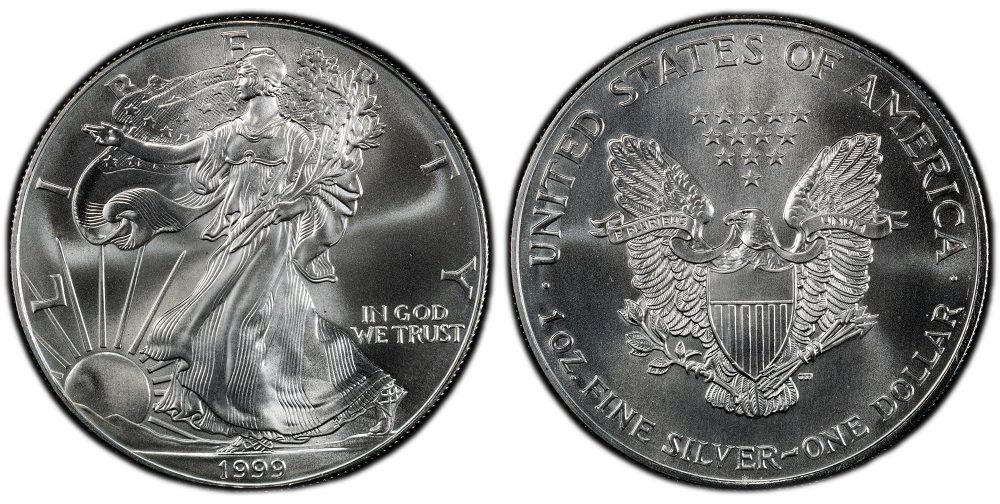
1999 Silver Dollar Value: Free Calculator + Complete MS70 Guide
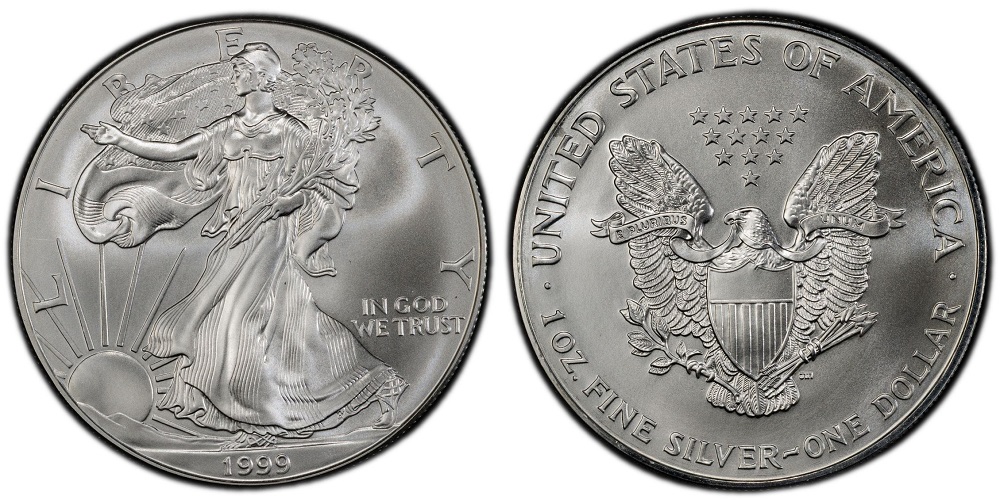
A perfect MS70 example of the 1999 American Silver Eagle sold for $33,110 at Great Collections — yet most of these coins trade at or near silver spot. Whether your coin is raw bullion, a graded MS69, or a rare Proof, this guide gives you a real number in seconds.
Free 1999 Silver Dollar Value Calculator
Select your coin's mint, condition, and any errors to get an instant value estimate.
Step 1 — Mint Mark
Step 2 — Condition
Step 3 — Errors or Special Features
This calculator works best if you already know your coin's condition and mint mark — if you're not sure yet, there's a free 1999 Silver Dollar Coin Value Checker online tool that lets you upload photos and get an AI-assisted identification before using this form.
Describe Your 1999 Silver Dollar for a Detailed Assessment
Type a description of what you see on your coin and we'll analyze it for key value indicators.
Mention these things if you can
- Mint mark (none or "P")
- Proof or bullion strike?
- Any visible marks or spots
- Grading slab present (PCGS/NGC)?
- Grade on the slab (MS69, MS70, etc.)
Also helpful
- Unusual color (gold/yellow tint?)
- Size seems off or edge looks wrong
- Design seems shifted or doubled
- Surface impressions from debris
- Original government packaging present
Skipped the calculator?
It takes under 30 seconds to get a value estimate for your 1999 silver dollar — just pick your mint, condition, and any errors.
Use the Free Calculator →MS70 Condition Rarity Self-Checker
The 1999 Silver Eagle's MS70 is its most important value driver. Only ~146 examples have been certified in this perfect grade by PCGS. Check whether your coin might qualify.
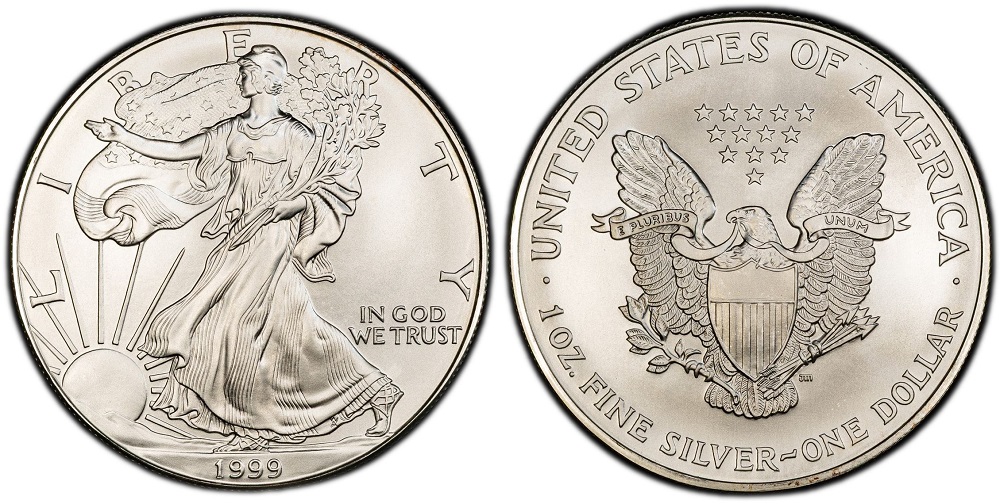
Common MS69 (value ~$125–$140)
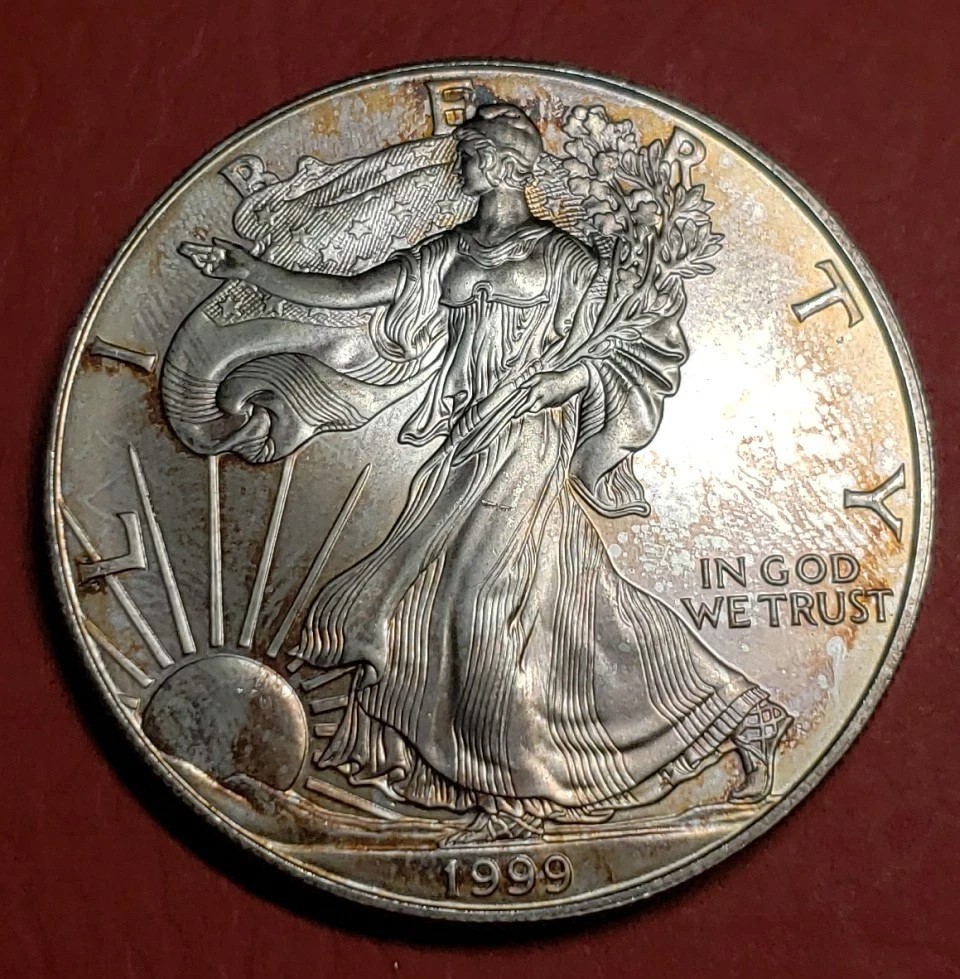
Under a 10× loupe, minor contact marks are visible on the high points of the Walking Liberty obverse — typically on the head, raised arm, or the eagle's breast feathers on the reverse. Fields may show slight haze. This is where the vast majority of certified 1999 Silver Eagles land.
Rare MS70 (value $1,000 – $7,500+)
Absolutely no contact marks, abrasions, or imperfections of any kind, even under strong magnification and proper light. The Walking Liberty design shows crisp full strike detail on all high points. No milk spots, no die polish lines disrupting fields. The coin looks completely pristine from every angle.
MS70 Identification Checklist
1999 Silver Dollar Value Chart at a Glance
Values below reflect recent market data and auction results. For a complete illustrated 1999 dollar identification walkthrough with step-by-step grading photos, see this detailed 1999 silver dollar identification guide and reference. Values change with silver spot price — treat these as current-market estimates.
| Variety / Type | Raw / Lower MS | MS68–MS69 (certified) | MS70 / PR70 (perfect) |
|---|---|---|---|
| 🥇 Bullion Strike (MS70) | Silver spot + ~$15 | $125 – $140 | $1,000 – $7,500+ |
| Bullion Strike (Raw BU) | $45 – $70 | $125 – $140 | $1,000+ |
| 1999-P Proof (DCAM) | $50 – $65 | $100 – $140 | $450 – $600 |
| Struck-Through Error | $150 – $300 | $450 – $860+ | Rare — consult dealer |
| 🔴 Broadstrike Error | $50 – $100 | $100 – $200 | Rare — consult dealer |
| Mercanti Signature Label (MS69) | — | $140 – $200 | $5,000 – $9,000+ |
🪙 CoinKnow is a fast on-the-go app for estimating your silver eagle's value using photos and grade comparison — a coin identifier and value app.
Everything on This Page
The Valuable 1999 Silver Dollar Errors (Complete Guide)
The 1999 American Silver Eagle's high-value planchets meant the U.S. Mint exercised strict quality control — but errors still escaped. Meanwhile, the simultaneous running of the Susan B. Anthony and Sacagawea dollar programs that year created some of the most dramatic transitional errors in modern coinage. Below are the five most important error varieties, in order of rarity and collector demand.
 Most Common Error
$450 – $860+
Most Common Error
$450 – $860+
Struck-Through Error
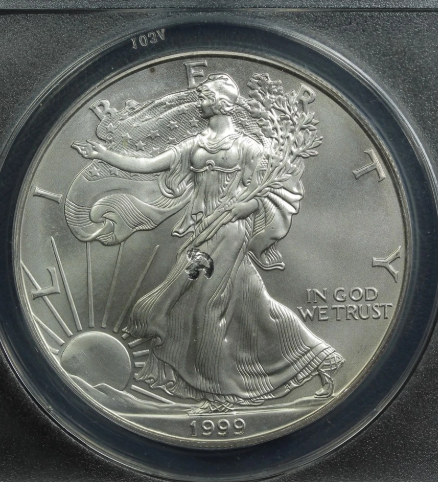
A struck-through error occurs when foreign material — fabric, wire, grease, or plastic — becomes lodged between the die and the planchet at the moment of striking. The resulting coin bears a raised or incuse impression of the obstruction, permanently embedded into the coin's surface. On the 1999 Silver Eagle, struck-through errors are the most commonly encountered error type, primarily because the high intrinsic value of one-ounce silver planchets meant more careful handling — but not perfect handling.
Visual identification depends on the type of material involved. Cloth or burlap impressions leave a distinctive textile weave pattern pressed into the silver surface. Wire impressions create a thin linear channel across the field or design. Grease-filled die errors are a related phenomenon, producing areas of flat, incomplete striking where hardened lubricant blocked the die's relief from transferring to the planchet. The struck-through area typically contrasts sharply with the surrounding brilliant silver field, making authentication relatively straightforward for certified examples.
Collector demand for struck-through Silver Eagles centers on dramatic, clearly identifiable examples rather than subtle impressions. A 1999 reverse struck-through error graded MS69 retails for approximately $450, while a documented 1999 reverse struck-through plastic example graded MS66 sold at auction in January 2012 for $862.50, confirming the premium these pieces command when the error is well-documented and the underlying grade remains strong. Always insist on PCGS, NGC, or ANACS certification before purchasing any struck-through example, as post-mint damage can mimic the appearance of a genuine error.
 Best Kept Secret
$50 – $200
Best Kept Secret
$50 – $200
Broadstrike Error
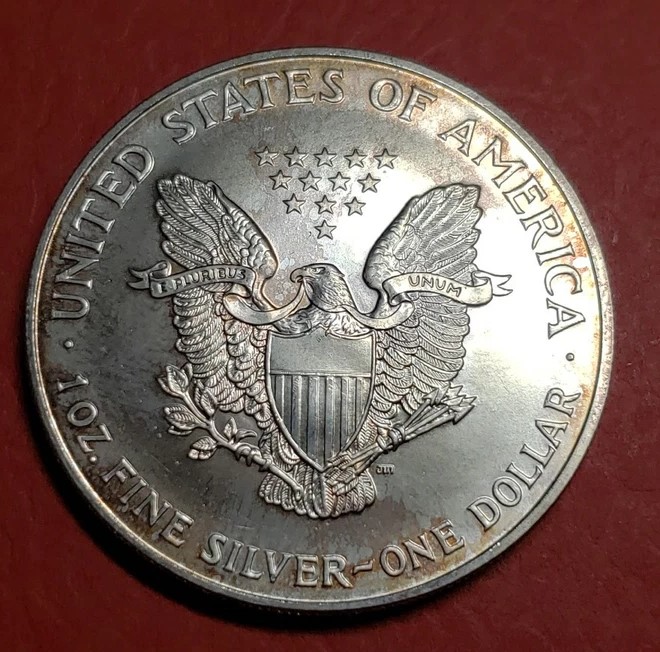
A broadstrike error occurs when the retaining collar — the ring-shaped mechanism that constrains the planchet during striking and imparts the reeded edge — fails to engage properly. Without the collar's constraint, metal flows freely outward under the enormous hydraulic press pressure, producing a coin noticeably wider and proportionally thinner than a normal specimen. The edge, which would normally bear the coin's distinctive reeding, instead appears flat, plain, and slightly irregular where the metal spread beyond the collar's intended boundary.
On the 1999 American Silver Eagle, a genuine broadstrike will measure noticeably more than the standard 40.6mm diameter — typically 28–32mm is cited for smaller dollar coins, but for the larger silver eagle format, any expansion beyond 40.6mm accompanied by a smooth, reed-free edge is diagnostic. The key identification test the numismatic community uses is the edge: standard 1999 Silver Eagles bear approximately 150 reeds on a properly struck example. A broadstruck silver eagle will show a completely plain, smooth edge with no reeding whatsoever — this single feature immediately confirms the collar failure.
Broadstrike errors are considered accessible entry points into the 1999 Silver Eagle error market, with typical authenticated uncirculated examples trading between $50 and $100. More dramatic examples with significant diameter expansion can command $150–$200 or slightly above from specialized error collectors. Because the coin's expanding metal often produces a slightly mushy or incomplete design in the peripheral areas, grades above MS65 for broadstrikes are uncommon, which caps ultimate values relative to more dramatic error types.
 Most Valuable ASE
$450 – $1,750+
Most Valuable ASE
$450 – $1,750+
Double Strike Error
A double strike error occurs when a coin remains in the press chamber after its first complete strike and receives a second impression from the descending dies before the ejection mechanism removes it. The result is two overlapping, ghost-like sets of design elements: Walking Liberty's portrait appears twice on the obverse, offset from one another by the degree of planchet movement between strikes. The reverse eagle similarly shows doubled features. When the second strike occurs with significant off-center displacement — 50% or more — these become among the most visually dramatic and valuable American Silver Eagle errors ever documented.
The critical visual indicator is the presence of two complete or partial design impressions at different positions on the planchet. If both strikes landed in the collar (double-struck in-collar), the coin retains a proper reeded edge and the two overlapping designs are constrained within the coin's normal diameter. If the second strike was off-center and outside the collar, the rim may be irregular on one side, with a crescent of blank planchet visible. The high points of both the primary and secondary impressions should show matching die characteristics — this rules out post-mint double exposure photography or mechanical damage masquerading as an error.
For the 1999 Silver Eagle specifically, the most prized double strike examples involve a second strike 75–80% off-center, graded MS65 to MS66, valued at approximately $1,350–$1,750 per documented market data. More modest double-struck-in-collar examples trade between $200 and $300 for authenticated pieces in typical grades. The drama of the displacement is the primary value driver; dramatic multi-strike errors with large blank crescents command the highest premiums from specialized error collectors at major auction houses.
 Most Famous
$10,000 – $16,800+
Most Famous
$10,000 – $16,800+
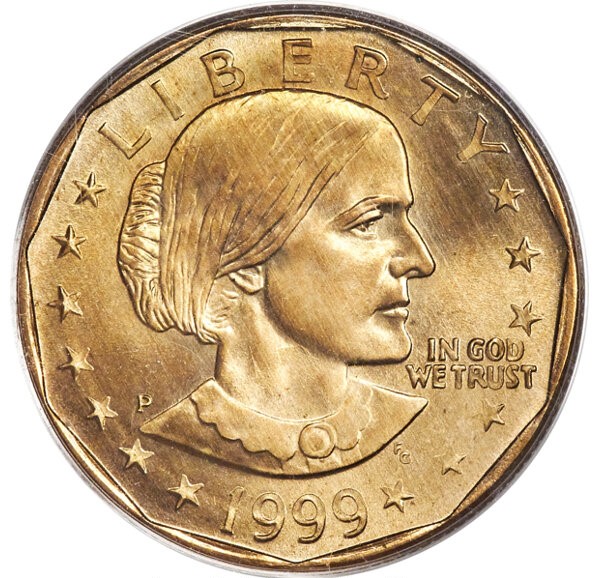
SBA Dollar — Wrong Planchet (Sacagawea Brass)
This is widely considered the crown jewel of 1999 dollar coin errors and one of the most celebrated transitional errors in modern U.S. coinage history. In 1999, the U.S. Mint was simultaneously producing the final year of the Susan B. Anthony dollar series and beginning production of the manganese-brass Sacagawea dollar at the same Philadelphia and Denver facilities. When manganese-brass Sacagawea planchets inadvertently entered the SBA dollar striking press, the result was visually astonishing: Susan B. Anthony's familiar portrait struck in brilliant golden color instead of the standard copper-nickel silver-toned finish.
The visual identification is immediately striking without any numismatic experience. The coin displays the standard SBA dollar obverse design — Anthony's portrait with the flowing hair, inscriptions, and date — but rendered entirely in the distinctive yellow-gold color of the manganese-brass alloy. The edge also differs: SBA dollars normally bear 133 reeds, but the manganese-brass planchet's different metal flow properties may produce slight edge irregularities. Weight is the definitive test: a genuine example weighs approximately 8.07 grams (matching the Sacagawea planchet specification) rather than the standard SBA dollar weight of 8.10 grams.
The 1999-P SBA on Sacagawea planchet ranks #43 in the book 100 Greatest U.S. Error Coins, an authoritative reference that highlights the error's historical and numismatic significance. Heritage Auctions has offered several examples: a PCGS MS64 example sold in January 2006 for $16,100, and a 2020 Heritage sale of a similar piece reached $16,800. Only eight to ten total examples are believed to exist across both Philadelphia and Denver production. Professional certification is absolutely essential — the value is entirely dependent on authentication by a major third-party grading service.
 Rarest of All
$10,575+
Rarest of All
$10,575+
SBA Dollar — Experimental Alloy Planchet
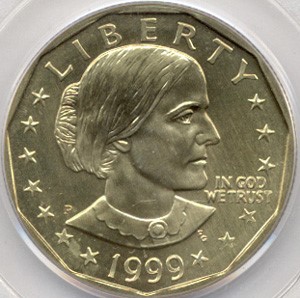
Separate from and even rarer than the standard Sacagawea planchet error, a distinct variant exists: 1999 SBA dollars struck on experimental manganese-brass planchets that were created during the Mint's alloy testing phase, before standard Sacagawea production planchets were in regular manufacturing. These experimental planchets came from a different, earlier stage of the Sacagawea dollar development process — they represent the Mint's early-stage metallurgical research rather than production-line planchets — making them a numismatically distinct and historically significant subcategory of the already-famous transitional error.
Visual identification of experimental planchet examples compared to standard Sacagawea planchet errors requires expert examination. Because the experimental manganese-brass alloy was harder than the production-specification alloy, these coins typically show somewhat softer striking detail — the die pressure that would produce sharp relief on a standard planchet transferred less completely to the harder experimental metal. This softness is most visible on the high relief areas of Anthony's portrait and the reverse eagle. The color is broadly similar to Sacagawea planchet errors (golden-yellow), but subtle differences in surface texture and luster may be observable to experienced specialists.
Only two examples of this specific experimental planchet error are known to exist, placing it among the genuinely elite rarities in the entire American coinage series, not merely the modern error category. One PCGS MS66 specimen sold for $10,575 at Heritage Auctions in February 2013, providing the primary market benchmark. The combination of extreme rarity (just two known), historical significance as a record of Mint development history, and the dramatic visual impact of the golden color on a familiar design makes this one of the most coveted modern U.S. error coins for advanced collectors.
Found one of these errors on your coin?
Run it through the calculator above — select your mint, pick the best-matching condition, and check the error box that matches. You'll get an estimated value range in seconds.
Calculate My Error Coin Value →1999 Silver Dollar Mintage & Survival Data
| Issue | Mint | Mintage | Notable |
|---|---|---|---|
| 1999 ASE Bullion Strike | Philadelphia (no mint mark) | 7,408,640 | Higher than average; Y2K silver demand spike |
| 1999-P ASE Proof (DCAM) | Philadelphia (P mint mark) | 549,769 | ~7% of total; one of the lower proof mintages in the series to that date |
| Total 1999 Silver Eagles | Philadelphia | 7,958,409 | Second-to-last year of Proof production at Philadelphia before moving to West Point |
How to Grade Your 1999 Silver Dollar
Worn / Damaged
Heavy contact marks, scratches, cleaning, or physical damage. Fields show loss of luster. Milk spots visible and extensive. May have been used as jewelry or otherwise mishandled.
~Silver spot valueMS63 – MS67
Circulated / Mid-Grade
Visible contact marks in the fields or on Walking Liberty's high points even to the naked eye. Luster present but interrupted. Strike may show weakness on eagle's breast feathers. Common for raw, unsubmitted bullion coins.
~$50 – $100MS68 – MS69
Near-Perfect
Contact marks visible only under 5× to 10× magnification. Strong luster with full cartwheel effect. Strike nearly complete on all design elements. Most carefully handled raw silver eagles land here when submitted to PCGS or NGC.
~$100 – $140MS70 / PR70
Perfect Grade
Absolutely no defects under any magnification. Complete, sharp strike on all design elements. No milk spots, no die flow lines disrupting fields. Extremely rare for the 1999 issue — only ~146 PCGS MS70s certified to date. This is where the serious premium lives.
$1,000 – $7,500+📸 CoinKnow can help you match your coin's surface condition against graded reference examples before you send it off to a TPG — a coin identifier and value app.
Where to Sell Your Valuable 1999 Silver Dollar
The right venue depends entirely on your coin's grade and whether it's certified. Here are the four best channels.
🏛️ Heritage Auctions
The leading numismatic auction house for high-grade and error 1999 Silver Eagles. Heritage has sold multiple MS70 examples including a $14,400 Mercanti-signature MS70 in April 2021. Best for certified MS70, PR70, or error coins — the competitive bidding environment maximizes prices for genuinely rare pieces. Expect a buyer's premium of 20–25%. Submit at least 6–8 weeks before the auction you want.
🛒 eBay
The best venue for raw BU, MS69, and common-date proof silver eagles. Active buyer competition keeps prices close to market. Check recently sold 1999 dollar prices and completed eBay listings before setting your starting price — using stale data is the most common seller mistake. Filter for "Sold" results to see real transaction prices, not asking prices. PCGS- or NGC-slabbed coins sell faster and for higher prices than raw examples.
🏪 Local Coin Shop
Fastest option for raw bullion-grade silver eagles — most dealers will pay close to silver spot for common-date, ungraded examples. Convenient if you need quick cash, but expect offers of 5–10% below market for higher-grade or certified coins; dealers need room for profit. Best used for coins with heavy milk spots or damage where grading costs wouldn't recover. Call ahead to confirm the shop purchases American Silver Eagles.
💬 Reddit r/Coins4Sale
Active peer-to-peer marketplace with knowledgeable buyers who understand Silver Eagle value. Good for mid-grade slabbed examples (MS68–MS69) where auction fees would eat into margins. The community appreciates honest photography and transparent descriptions. Requires a PayPal or Venmo account and some forum reputation. Avoid selling uncertified high-grade examples here — buyers will discount heavily without a slab to verify the grade.
Frequently Asked Questions — 1999 Silver Dollar Value
What is the value of a 1999 American Silver Eagle dollar?
A raw, uncirculated 1999 American Silver Eagle is worth approximately silver spot price plus a small premium — typically around $45–$70 depending on current silver prices. Graded examples command more: MS69 coins trade in the $125–$140 range, while perfect MS70 examples are worth $1,000 to over $7,500. The top recorded auction sale was $33,110 for an MS70 example sold at Great Collections in December 2013.
How many 1999 American Silver Eagles were minted?
The Philadelphia Mint produced 7,408,640 bullion-strike 1999 American Silver Eagles with no mint mark. The Philadelphia Mint also struck 549,769 proof examples, which carry the "P" mint mark and are known as the 1999-P Silver Eagle Proof. The proof mintage was one of the lowest in the series up to that point, representing only about 7% of the total silver eagles produced that year.
Why is the 1999 Silver Eagle so valuable in MS70?
Despite a relatively large mintage of 7.4 million coins, the 1999 American Silver Eagle is a significant condition rarity in perfect MS70. PCGS had long refused to grade Silver Eagles MS70 due to milk-spotting concerns and only reversed that policy around 2016. As a result, only a small number have been certified in that grade by PCGS, making certified examples genuinely scarce and commanding substantial premiums over MS69 coins.
Does the 1999 Silver Eagle have a mint mark?
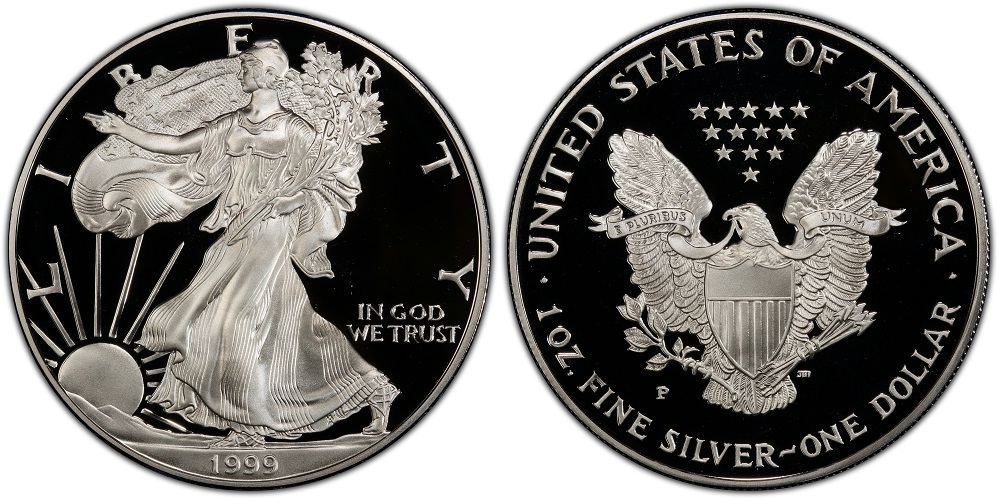
Regular bullion-strike 1999 American Silver Eagles have no mint mark — they were struck at the Philadelphia Mint but bear no mintmark identifier. The proof version, struck specifically for collectors and sold in presentation packaging, carries a "P" mint mark on the obverse below the date. The proof coin is sometimes called the 1999-P Silver Eagle Proof.
What errors exist on the 1999 Silver Eagle?
Major errors on 1999 Silver Eagles are rare due to high-value planchets and strict quality control, but struck-through errors (where debris was trapped between die and planchet) are the most commonly encountered. These typically show an impression of cloth, wire, or plastic on the coin's surface. A struck-through example graded MS69 has retailed around $450–$860. All errors should be authenticated by PCGS, NGC, or ANACS before purchase.
How can I tell if my 1999 Silver Eagle is genuine?
Genuine 1999 American Silver Eagles weigh exactly 31.10 grams and measure 40.6mm in diameter with a reeded edge. The obverse features Adolph A. Weinman's Walking Liberty design. Check the coin's weight on a precision scale; counterfeits often vary by 0.5g or more. For certainty, submit to PCGS, NGC, or ANACS for professional authentication. The coin's .999 fine silver content also means it will pass a magnet test (silver is not magnetic).
What is the 1999-P Silver Eagle Proof worth?
The 1999-P American Silver Eagle Proof is worth a modest premium over the bullion strike. In PR69 Deep Cameo condition, expect values in the $100–$140 range. The rarer PR70 Deep Cameo examples command significantly more, typically $450–$600 or higher depending on service and label. With a mintage of approximately 549,769, the proof is not especially scarce, but the PR70 population remains limited and collector demand is steady.
What does 'milk spots' mean for a 1999 Silver Eagle's value?
Milk spots are white, hazy patches that sometimes appear on American Silver Eagles after grading or storage. They are caused by residual chemicals from the minting process reacting with the coin's surface over time. A coin with visible milk spots cannot achieve MS70, and heavily spotted examples may grade as low as MS67 or MS68. Milk spots significantly reduce collector appeal and value — an otherwise pristine coin with heavy spotting may sell for close to silver spot price only.
Where is the best place to sell a 1999 Silver Eagle?
For raw or MS69 examples, eBay offers strong competition among buyers and typically achieves close to retail pricing. For MS70 or high-grade certified coins, Heritage Auctions or Stack's Bowers will reach the widest collector audience and often realize the best prices. Local coin shops are convenient but may offer below-market prices. For error coins or high-grade slabs, getting the coin authenticated by PCGS or NGC before selling dramatically increases buyer confidence and final sale price.
How do I grade my 1999 Silver Eagle at home?
Examine the coin under good lighting with a 10× loupe. MS70 coins show absolutely no contact marks or imperfections even under magnification. MS69 coins have minor contact marks visible only under magnification, often on the high points of the Walking Liberty design (the head, hands, and eagle's breast). MS68 and below show more obvious marks. Look for milk spots, hairlines from cleaning, and areas of strike weakness on the eagle's breast feathers.
Ready to find out what your 1999 silver dollar is really worth?
The free calculator takes under 30 seconds. Pick your mint, grade, and any errors — get an instant value range backed by real auction data.
Use the Free Calculator Now →